
Study Of Phishing, and Malware Warnings
The security of computer systems often relies upon decisions and actions of end users. In this paper, we set out to investigate user-centered security by concentrating at the most fundamental component governing user behavior – the human brain. We introduce a novel neuroscience-based study methodology to inform the design of user-centered security systems. Specifically, we report on an fMRI study measuring users’ security performance and the underlying neural activity with respect to two critical security tasks: (1) distinguishing between a legitimate and a phishing website, and (2) heeding security (malware) warnings. At a higher level, we identify neural markers that might be controlling users’ performance in these tasks, and establish relationships between brain activity and behavioral performance as well as between users’ personality traits and security behavior.
Our results provide a largely positive perspective towards users’ capability and performance vis-à-vis these crucial security tasks. First, we show that users exhibit significant brain activity in key regions associated with decision-making, attention, and problem-solving (phishing and malware warnings) as well as language comprehension and reading (malware warnings), which means that users are actively engaged in these security tasks. Second, we demonstrate that certain individual traits, such as impulsivity measured via an established questionnaire, can have a significant negative effect on brain activation in these tasks. Third, we discover a high degree of correlation in brain activity (in decision-making regions) across phishing detection and malware warnings tasks, which implies that users’ behavior in one task may potentially be predicted by their behavior in the other task. Finally, we discuss the broader impacts and implications of our work on the field of user-centered security, including the domain of security education, targeted security training, and security screening.
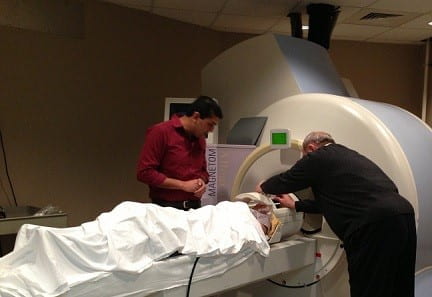
A participant performing task inside fMRI
People
Faculty
Student
- Ajaya Neupane (@UAB; PhD 2017)
External Collaborators:
- Rajesh. Kana (Asso. Professor; Department of Psychology UAB)
Publication
- Neural Signatures of User-Centered Security: An fMRI Study of Phishing, and Malware Warnings (Distinguished Paper Award)
Ajaya Neupane, Nitesh Saxena, Keya Kuruvilla, Michael Georgescu, and Rajesh Kana
In The Network and Distributed System Security Symposium (NDSS), February 2014
[pdf] - Neural Markers of Cybersecurity: An fMRI Study of Phishing, and Malware Warnings
Ajaya Neupane, Nitesh Saxena, Jose O Maximo, and Rajesh K Kana
In IEEE Transactions on Information Forensics and Security (TIFS), 2016.
[pdf] - Task-dependent Changes in Frontal-Parietal Activation and Connectivity during Visual Search
Jose O Maximo, Ajaya Neupane, Nitesh Saxena, Robert M Joseph, and Rajesh K Kana
In Brain Connectivity, 2016.
[pdf]
Media Coverage
- How your Brain is affected by Phishing Scams, BlogHer, Feb 10, 2015
- Los internautas temen a los hackers menos de lo que dicen, La Razon, Nov 30, 2014
- Our brains work hard to spot phishing scams, but still often fail, NakedSecurity, March 4, 2014
- Most People Can’t Tell the Difference Between a Real Website and a Scam, Motherboard, March 5, 2014
- Users’ brains scanned in bid to fix infosec, CSO, March 15, 2014
- Nehezen különböztetjük meg a valódi és az adathalász honlapoka (Hungarian), S.hu, March 10, 2014
- Neue Studie zu Phishing: Opfer kennen die Warnsignale nicht (German), Gulli, March 6, 2014
- Brain research tracks internet safety performance, dispels assumptions, identifies traits of those at-risk, Science Daily, February 28, 2014
- Study suggests users pay more attention to Internet safety than previously assumed, Phys.org, February 28, 2014
- Brain research tracks Internet safety performance, dispels assumptions, identifies traits of those at-risk, UAB News, Feb 27, 2014